|


|
The Unemployment Rate
The U.S. unemployment rate is a widely-watched rate that the news media report prominently. It gets this attention because a high rate is seen as a symptom of a malfunction in the economic system. Some people who are out of work are in financial distress, and thus one can expect that as the unemployment rate rises, the number of persons in financial distress rises as well. Most people consider a properly functioning economic system as one that has relatively few people in financial distress.
To measure the unemployment rate, the U.S, Department of Labor surveys 60,000 homes each month. Each household must answer a series of questions, and from these the breakdown in the table below is derived. Excluded from any consideration in determining employment-unemployment status are all those under 16 years of age and those in penal or mental institutions, sanatoriums, and homes for the infirm, aged, or needy. People are considered not in the labor force if they are not working for pay and have no interest in finding a job. Examples are retired persons, some housewives and students, and disabled persons. People are considered employed if they work for pay any time in the week that includes the 12th day of the month, or if they worked unpaid fifteen hours or more in a family-operated business, or if they were temporarily absent from a regular job because of illness, vacation, industrial dispute, or similar reason. People are considered unemployed if they do not work during the week containing the 12th day of the month, are available for work (except for temporary illness), and have looked for jobs within the preceding four weeks. Also considered as unemployed are those who do not look for jobs because they are on layoff or because they are waiting to start a new job within thirty days.
EMPLOYMENT STATUS OF THE NONINSTITUTIONAL POPULATION 16 YEARS AND OVER, 1982
(numbers in thousands)
|
Noninstitutional Population |
173,939 |
Not in Labor Force |
62,067 |
Labor Force |
111,872 |
Employed |
101,194 |
Unemployed |
10,578 |
|
|
Unemployment Rate |
9.5% |
| (Source: Monthly Labor Review, December 1983, p. 65) |
The unemployment rate is found by dividing the total number of unemployed by the labor force. The result is then seasonally adjusted. Seasonal adjustment is a procedure that many statistical series undergo. It eliminates movements that occur each year in a seasonal pattern. For example, each spring when school lets out there is a flood of new job seekers, and each fall as school resumes there is a reduction in those looking for and who have work. If this regular seasonal variation is not eliminated, the numbers will suggest that the economy is having difficulty each spring but that it recovers each fall.
The computation of the unemployment rate is done by assigning everyone in the population to one of four boxes. Starting with the whole population, there are some who cannot choose to work because they are too young or because they are in prisons, mental hospitals, or other institution. What is left is the noninstitutional population. Some of them choose not to work, and they are not in the labor force. What is left is the labor force, those who choose to work. Some of them have jobs--the employed--and some of them do not--the unemployed. The picture below summarizes this process of fitting everyone into a box.
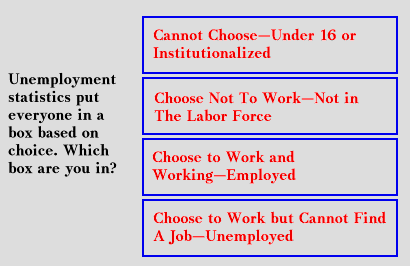
However, not everyone fits neatly and clearly into one box. As a result, there are some problems with interpreting what unemployment rates really mean.
Copyright Robert Schenk
|
